
- Well & Truly Balanced
- About
- Services
- What is Tapping (EFT)?
- Tapping (EFT) for Anxiety Management
- Tapping (EFT) for Children
- Tapping (EFT) for Couples
- Tapping (EFT) for Families
- Tapping (EFT) for Grief Support
- Tapping (EFT) for Individuals
- Tapping (EFT) for Managing Burnout
- Tapping (EFT) for Mums (Babies)
- Tapping (EFT) for Mums (Nest Egg)
- Tapping (EFT) for Stress management
- Tapping (EFT) for Trauma Recovery
- Blog
- Contact
What is EFT Tapping?
Emotional Freedom Techniques — usually shortened to EFT and commonly called Tapping — is a mind-body technique that combines focused attention on thoughts and emotions with gentle tapping on specific acupressure points.
It may look a little unusual the first time you see it. The technique itself, however, is surprisingly simple to learn.

So, what actually happens when you tap?
During an EFT session, we begin by identifying something you would like to work with.
That might be an emotion such as anxiety, sadness, anger or guilt. It might be a particular situation, memory, worry or belief about yourself.
While gently keeping some attention on that experience, you tap with your fingertips on a sequence of points, primarily around the face and upper body.
I guide you through the process, including where to tap and what to focus on.
We regularly pause to notice whether anything has changed and allow the session to develop from there.
Where do you tap?
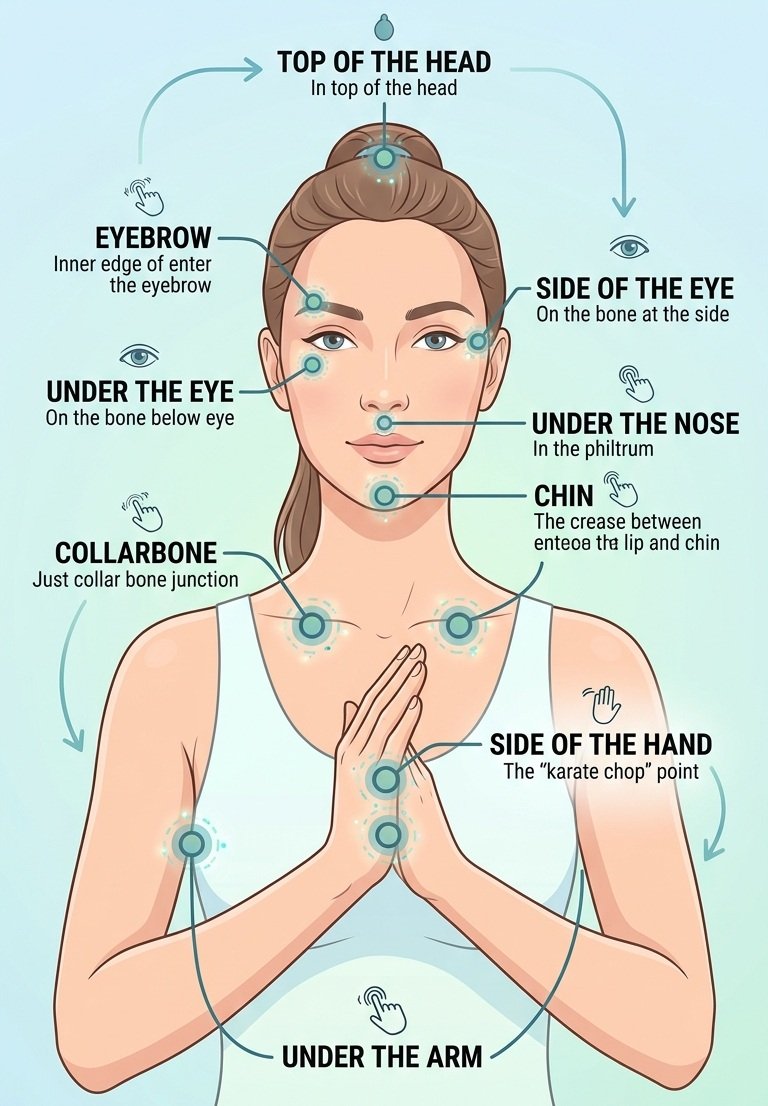
A typical EFT tapping sequence uses several easily accessible points, including:
- Side of the hand
- Eyebrow
- Side of the eye
- Under the eye
- Under the nose
- Chin
- Collarbone
- Under the arm
- Top of the head
There are no needles and no special equipment.
You simply use your own fingertips.
Why work with the feeling as well as the thought?
We often assume that if we understand something intellectually, our emotions should follow.
But human beings don’t always work like that.
You can know a presentation isn’t dangerous and still feel your heart racing before you walk into the room.
You can know someone else’s behaviour wasn’t your fault and still carry guilt.
You can know your child leaving for university is a positive step and simultaneously feel an enormous sense of loss.
That gap between what we know and what we feel is one reason I find EFT so interesting.
Rather than arguing with the emotion or telling ourselves we shouldn’t feel it, tapping gives us an opportunity to acknowledge what is actually present and work with that response.

A gentle approach to difficult experiences.
One concern people sometimes have about emotional work is the idea that they will have to describe every detail of a painful experience.
That isn’t necessarily the case with EFT.
We can approach difficult material gradually and, where appropriate, work with the emotions surrounding an experience without requiring you to describe everything in detail.
You remain in control of what you choose to share.
If something feels too much, we can slow down, change direction or stop.
For me, feeling safe and heard is far more important than rushing towards an outcome.

There isn’t one “correct” response.
Everyone experiences tapping differently.
Some people notice a feeling becoming less intense. Others find their perspective on a situation begins to shift.
Sometimes another thought, memory or emotion comes to mind and gives us something new to explore.
At other times, change is much more subtle.
I don’t expect you to produce a particular reaction, and there is no need to tell me something has changed if it hasn’t.
We simply stay curious about what you notice.

What if I’m sceptical?
You’re allowed to be.
You don’t need to adopt a particular belief system to attend a session with me, and I will never ask you to pretend that something feels different when it doesn’t.
I would much rather you tell me honestly what you are experiencing.
Curiosity is enough.

A tool you can use beyond our sessions.
Yes. In fact, this is one of my favourite things about EFT.
Once you know the basic tapping points, you can use simple tapping yourself.
That might be when you notice yourself becoming stressed, before an event that makes you anxious, when you are struggling to settle your thoughts, or simply as part of taking a few minutes for yourself.
More complex or deeply distressing experiences are often better explored with an appropriately trained practitioner, but basic tapping can become a useful addition to your own emotional wellbeing toolkit.

Understanding the role of EFT.
EFT is a complementary mind-body approach to emotional wellbeing.
It should not be regarded as a replacement for appropriate medical treatment, psychiatric care or psychological therapy where these are required.
I will always be open about the scope of the support I provide. If something is outside that scope, seeking the appropriate professional support is important.
You should never stop or alter prescribed medication or medical treatment based on EFT without discussing this with the healthcare professional responsible for your care.

A tool you can use beyond our sessions.
Yes. In fact, this is one of my favourite things about EFT.
Once you know the basic tapping points, you can use simple tapping yourself.
That might be when you notice yourself becoming stressed, before an event that makes you anxious, when you are struggling to settle your thoughts, or simply as part of taking a few minutes for yourself.
More complex or deeply distressing experiences are often better explored with an appropriately trained practitioner, but basic tapping can become a useful addition to your own emotional wellbeing toolkit.
Support from wherever you happen to be.
All sessions are available online, which means we can work together wherever you live.
Let’s Talk
Your Personal Approach
Online EFT Sessions
Something You Can Take With You
A few things you might be wondering…
Do I need to have tried EFT before?
Do I have to talk about everything that has happened to me?
How many sessions will I need?
Can we work together if I live outside the UK?
Is EFT a replacement for medical treatment or psychotherapy?
Could EFT be right for you?
Reading about tapping can explain the technique, but what really matters is whether the approach feels right for you.
If you are curious, you are welcome to get in touch and tell me a little about what has brought you here.
